


How did the rich enjoy their feasts?
- Sengoku no Bushido
- Oct 26, 2024
- 6 min read


The feasts of even the upper echelons of society at this time, while they could be sumptuous, were usually far removed from their Heian period counterparts in grandeur and opulence. By our period, the heavily zen-influenced concepts of ‘wabisabi’ (beauty in simplicity) had set in so heavily that quite often people of most classes tended to eat very similar forms of meals. The difference being less in the meals themselves but rather the rich could invest more in their meals to be fancier if they so wanted.
Despite this socio-cultural effect, rich dinners still existed. Therefore, how did they work? Curiously, we have a source in the form of an account written by Portuguese Jesuit missionary, João Rodrigues, in the late 16th century. In paraphrasing from his account, he describes the following:
3 rounds of 3 drinks
Before any form of eating began, sake would be served in shallow bowls called sakazuki. There were 3 rounds of drinking, with each round having three drinks; altogether, 9 drinks. It was traditional to drink in pairs, either with a friend or with a former enemy to show reconciliation or forgiveness between the two. This was also done between two individuals when “they make a conspiracy, alliance or promise that must be fulfilled at all costs; they also do this when they take oaths of loyalty to each other, sometimes mixing in with the wine some drops of blood which both draw by pricking their finger, and then both drink the wine mixed with blood” (João Rodrigues). As a result, refusing a drink at this stage of the feast was the height of rudeness.
Non-edible appetisers
While the drinking ceremony was happening, certain appetisers were passed around the table like dried chestnuts, dried abalone, or dried kelp. These were not for eating but rather as a form of symbolism. However, you still pretended to eat some of them. Specifically, “Take the second strand of flattened abalone from the front and bring it to your mouth, and then tuck it away in your pocket” (Okusadono yori soden no kikigaki, 1535-73).
Edible appetisers
One text gives an example of one of the appetisers that, in contrast to the above, would be edible and eaten. If there “has been a long interval of sake drinking after a light meal, it is appropriate to serve chilled barley noodles as a snack” (Culinary Text of the Yamanouchi House, 1497).
Entree, Gifts, Entertainment, and Buns
It was then usually customary to then be served an entree that could include grilled fowl, seafood, vegetable dishes, mochi and additional sake. Afterwards, gifts would be exchanged between the hosts and guests. These could range from anything from swords, horses, fine clothes, silver, and so on. This was immediately followed by entertainment from dancers, musicians, and theater, during which the guests could enjoy snacks such as buns filled with red bean paste. The performers could then be gifted with items such as new clothing and money. After this, the actual banquet feast (Honzen Ryōri) could begin.
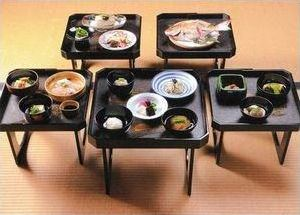
Honzen Ryōri
This feast used a very elaborate method of food presentation. All of the guests would be seated on the floor, with the most prominent guest or host seated in a more prominent location. Everyone else was seated in order of their importance from the most prominent to the least, very similarly to Europe at this time. As one can imagine, where a guest was seated could be a very delicate decision and one that could have various repercussions.
Every part of the feast such as when you got to eat, what foods you got to eat and what foods you had presented to you, were all meant to reinforce your position in the hierarchy. Food would be presented usually on three trays. João Rodrigues describes one of these banquets as he witnessed one in 1600. He describes the trays in the following way:
“Nowadays at banquets they usually place three principal trays in front of each guest. All the trays are generally of white cedar wood square in shape and with legs a span in height; the tray placard in the centre is the highest and has another tray on either side.”
Each tray would have different dishes, the set up could have depended on a variety of things. The most formal way to do it, it seems, was the main tray would have seven side dishes and a big bowl of rice on the lower left corner as well as a salt cellar. The right tray would have five side dishes, and the left tray would have three. On each tray there would also be some form of soup. On some occasions it appears to be that there could be a fourth tray which was referred to as an ‘additional tray’ rather than the fourth tray (‘4’ in Chinese and Japanese being a homonym of the word ‘death’).
Every tray was meant to include food that had five colours: yellow, red, green, white, and black.These colours were achieved in various ways, one of the prescribed ways to do this was:
“Use conger eel for the colour white. Bonito is for the colour red. Black is made from dried sea cucumber. Green is shark. Yellow is dried squid. It is best to slice these finely” (Sōgō ōzoshi, Ise Sadayori, 1529).
Every part of this meal was about showmanship and display, including some of the food preparations. There appears to be a knife ceremony likely known as shikibōchō, in which the hochonin (carving knife man/men) would fillet a fish or carve a fowl with a blade without touching the food with their hands. Sometimes very large dishes were prepared and put on display in the middle of the room, which could be things such as a duck that had been plucked and re-feathered while placed in a position so that it looked like it was about to take off. All of these dishes and even the ingredients were heavily laden with symbolism.
You were not allowed to begin to eat until given the appropriate social cue from the most prominent guest or host which would also include a cue on what item to eat at that time. This was done not only out of deference, but also so each guest had enough time to fully appreciate the meal in front of them. When you were finally given the cue to eat, the guest would begin by “wetting their chopsticks in the soup on the main tray and picking up the rice bowl; after eating rice, sip the soup, but do not eat any morsels in it” (Okusadono yori soden no kikigaki, 1535-73).
After this, you were to take your chopsticks and pick up a single grain of salt from your salt cellar, then eat some rice, then sip more soup, and only then could you then try one of the other side dishes. However, not all of the dishes on your tray would be edible, some of these would be takamori, as explained by João Rodrigues:
“In these banquets, many of the dishes were served on plates in the form of pyramids neatly arranged with their corners as in the Chinese fashion, and it was from China that they derived their origin; but they were served only for decoration and were there to be looked at and not eaten.”
However, it was still expected that you would pretend to eat these as a form of etiquette. You were to “Remove the chopsticks from the tray, or pretend to remove them, and signify that you have eaten by making a noise with the chopsticks” (Annual Rites of the Kemmu Era, 1330).
One of these elaborate dishes that was not meant to be eaten was abalone, which could be prepared thusly:
“Attach streamers to the abalone, then as a base attach seven or nine waves made from paper of five colours cut into round pieces” (Okusadono yori soden no kikigaki, 1535-73).
Or, it could be a spiny lobster dish designed to look like a boat:
“The shell is opened, and the meat is served upon it. Raise the feelers up like a ship’s masts, and stand the legs off to the sides…it is best served with painted decorations on it in silver and gold” (Shijō School Text, 1489).
Out of all the dishes served, only a number of them would be edible. Specifically, these would be grilled foods, rice, soup, pickled vegetables, and possibly thin slices of raw fish (similar to sashimi), “their highly thought of raw fish cut into small pieces; along with it there will be a dish containing a tart sauce or one which burns like mustard [wasabi?], and this takes away the rawness of the fish” (João Rodrigues).
Godan - After Meal
Occasionally, this would be served after the Honzen Ryōri, likely because the amount of inedible dishes meant the guest would still be peckish afterwards. These would be heartier and more filling meals. References: I., Naomichi. (2001). The History and Culture of Japanese Food. New York, USA: Routledge. Tasting History with Max Miller. (2024). Feeding the Shogun: The Feasts of Feudal Japan. [YouTube]: https://www.youtube.com/watch?v=eXQA6CsBpig.


Comments