


Armour: The Dô (Cuirass)
- Sengoku no Bushido
- Aug 17, 2024
- 4 min read

Updated: Oct 19, 2024
Before discussing Japanese armour, it is important to discuss the terms associated with the armour and its various construction methods/pieces/etc. Due to the central view of Japanese armour being on the dô (cuirass), each suit of armour is usually defined by the type of dô.
Ita and Sane= Sane refers to scales of some kind, whereas Ita refer to the individual lames that make up the dô. For example, Koz(s)ane refer to the many individual scales with complex lacings one sees in earlier forms of armour (15th century and earlier). Kiritsukesane refers to the lames with the scaled edges designed to look like individual scales. Ita-mono refers to the flat-edged individual lames.
Mai = A piece that is a part of the overall dô, defined by its method of being attached by a hinge of some kind. For example, a five-piece dô (utilising 5 hinges, norm of our period) would be referred to as a ni-mai-dô.
Nagakawa = The part of the dô that covers the sternum to just above the waist.
Tateage (mae - front, ushiro - back) = The piece of armour directly above the nagakawa. This is not a part of the kanagu mawari (see below).
Kanagu mawari = The part of the dô that is above the nagakawa and surrounding the Tateage. The kanagu mawari are comprised of a breast board (muna-ita) that is directly above the tateage, a back of upper shoulder board (oshitsuke-no-ita, armpit plates (waki-ita), and then the wadagami (shoulder straps).
Kusazuri/Gessan = A tasset suspended from the bottom of the dô.
Odoshi = The lacing.
Types of Cuirass
There were many variations of helmets and armour in the Sengoku period, and the largest change of the design occurred after 1540 with the arrival of guns; no matter where in the world one is, one can notice that the armour always evolves to try and beat the weapons. Throughout this research journal, one will often see the term ‘dô’ which refers to the cuirass. In our era, there appear to be three common forms of ‘dô’: Haramaki, Dou-maru, and Mogami. This research journal will address each style separately.
Haramaki
Haramaki-dô appeared around 300-400 years before the 16th century as another alternative to the older O-yoroi form of armour. It is typically characterised by having multiple sections that form around the body with a small gap at the back. This gap could sometimes be covered by a separate piece of armour (nicknamed coward's plate), though this was not always done. Below is an example of a period haramaki-dô, retaining leather kozane for the kusazuri (tassets) to reduce overall weight (Goetz, 2023):

Note the side and rear images to show the small gap at the back:

Dou-Maru
Dou-maru was a contemporary of the haramaki dô and continued to be used for centuries after, like the haramaki. It was quite similar to its counterpart, although it joined at the side rather than leaving a gap at the back. Below is an illustration of a kin (steel) dou-maru using kozane construction and kebiki lacing (Goetz, 2023), note the 5 sections of the armour in total which could have metal or leather hinges:

Mogami-dô
The earliest mention of mogami-dô, Goetz (2023) claims, is in the early 1570s as can be seen in this written armour order that mentions an ‘okegaha-dô’:

When these first appeared, the only difference between them and earlier armours (eg: dou-maru, haramaki) is that the dô itself was constructed out of flat edged ita-mono as opposed to scales or scale facade lames. Because every scale was attached to a single board when it came to kozane or iyozane, using a single piece of metal on this board was less time-consuming (Bryant 1994, Goetz 2023). Something to note is that a mogami dô can still be made to the style of a haramaki or dou-maru, depending on where the armour opens (haramaki = rear, dou-maru = side). Otherwise, just like the haramaki and dou-maru at this time, the mogami-dô remained a 5-piece (gô-mai) box-like cuirass which could have kebiki or sugake lacing.
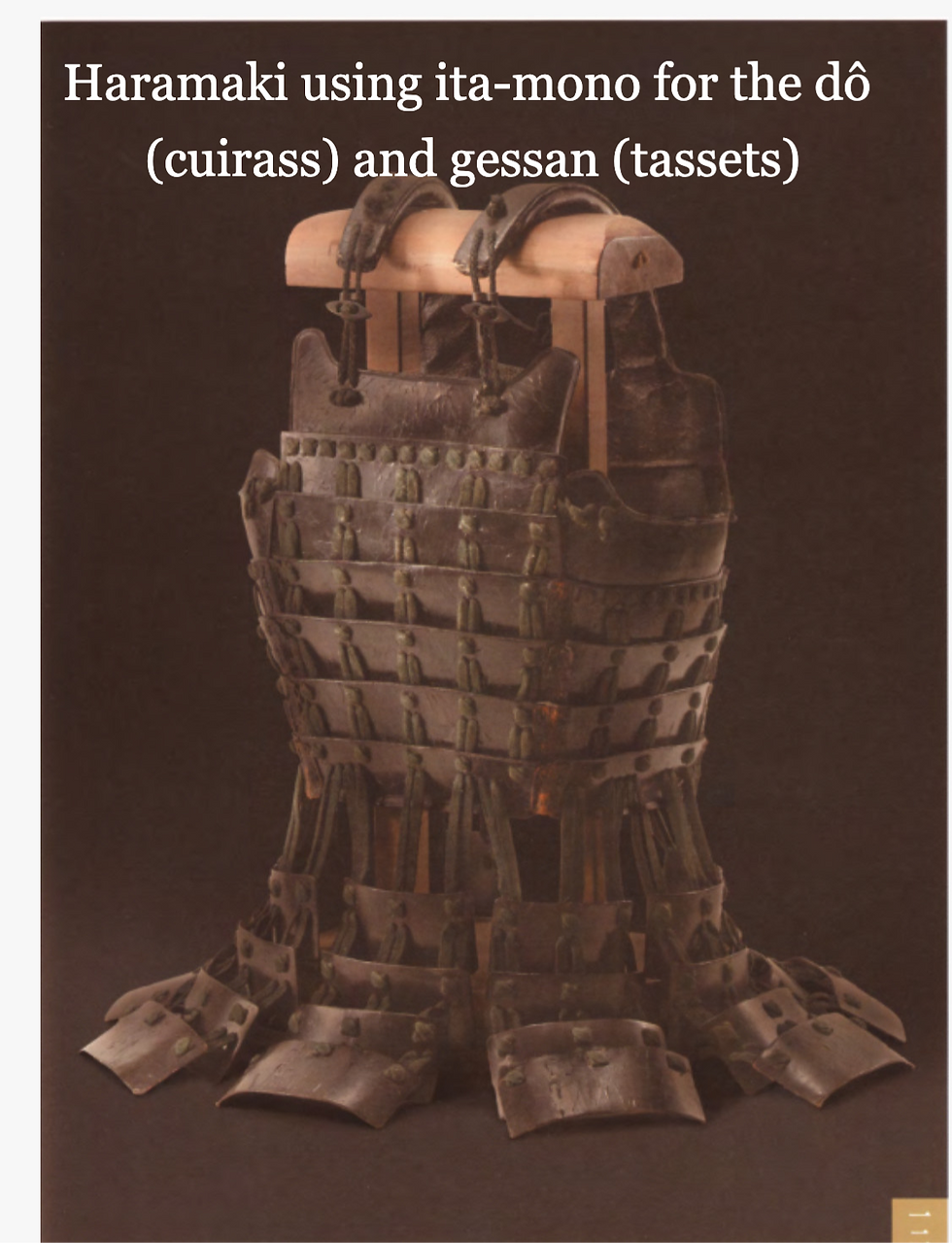
To the right is an example of the above, in this case being a mogami-dô in a haramaki construction with sugake lacing.
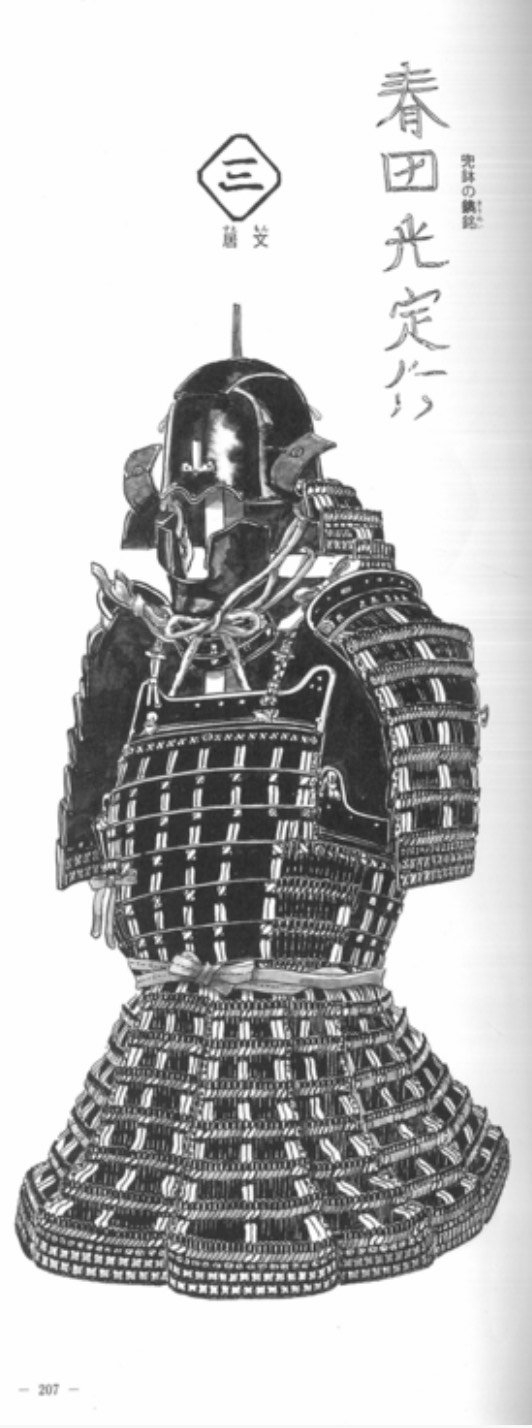
It is worth noting that while a dô may use ita-mono, the kusazuri (tassets) could still use kozane or kiritsukesane for example, or use sugake lacing for the dô but kebiki lacing for the kusazuri. In other words, it is also historical to mix and match them.
One such example of this mixing and matching is below, an illustration of an armour worn in the Ishiyama Hoganji War in the late 1570s by Inaba Yoshimichi (Goetz, 2023). Note the combination of ita-mono and kozane. A picture of the original is also shown next to it.

Other Dô:
There were more localised forms of dô that were also used at this time. While it is uncertain how much these travelled out of their provinces and therefore not much time will be spent discussion them at this stage, one of these is the famous Sendai-dô (formerly: Yukinoshita-dô). One extant example is pictured below (Goetz, 2023):

Reference: A., Goetz. (2023). The Okegawa Dou: Deconstructing Pop History. Retrieved from: https://www.militaria.co.za/nmb/topic/44635-the-okegawa-dou-deconstructing-pop-history/.


Comments